English
Choosing the right ERW pipe is not only a matter of price; it is a matter of weld quality, dimensional consistency, traceability, and fitness for the intended service condition. Buyers in oil and gas, water transmission, structural fabrication, piling, mechanical engineering and general industrial supply often use the term ERW loosely, but the procurement result depends on details such as steel grade, outside diameter, wall thickness, end finish, testing scope and coating requirement. If those points are not clearly aligned at the quotation stage, the buyer may receive a pipe that looks acceptable on paper but creates avoidable problems during fabrication, welding, threading, pressure testing, or field installation.
For that reason, this article is designed as a practical B2B guide rather than a generic overview. It explains how ERW pipe is produced, how weld seams are controlled, which inspection methods are common, when ERW is a better commercial choice than seamless pipe, and how a buyer can build a quotation request that saves time and reduces risk. Throughout the article, the goal is simple: help engineers, contractors, importers and procurement teams evaluate supply more efficiently and create a clearer path from technical inquiry to purchase decision.
JRSK works with international buyers who need dependable pipe supply, clear mill communication, and fast confirmation of standard, grade and inspection requirements. The guide below is therefore written to support both Google search intent and real purchasing conversations. It is also structured with definition-led sections so that readers, AI assistants and search engines can quickly extract clear answers.
Electric resistance welded tube is a welded steel tube made by forming steel strip into a round shape and heating the joining edges with electrical resistance so the seam is welded without adding filler metal.
In the market, buyers may search for ERW pipe, HFW pipe, welded tube or electric resistance welded tube. In many practical supply conversations, HFW and ERW are closely related because the welding energy is generated electrically and the seam is produced under pressure at the strip edges. The product is widely used because it combines efficient production, good dimensional consistency and commercial competitiveness across a wide range of diameters and wall thicknesses.
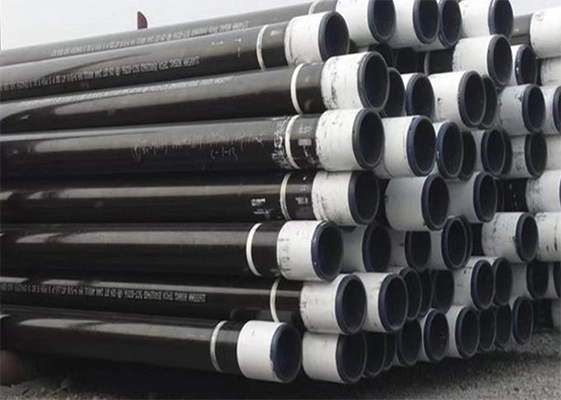
ERW pipe is commonly supplied in carbon steel grades for pressure service, line pipe service, mechanical service, water transmission and structural applications. Depending on the destination market, the buyer may request compliance with ASTM, API, EN, JIS or project specifications. The typical commercial advantages include stable supply, short production cycles for standard sizes, and good availability in straight length packages such as 6 m, 9 m or 12 m. For many projects, ERW offers the performance needed at a lower total procurement cost than alternative seamless products.
That said, not all ERW pipe should be treated as equal. The final performance depends on edge preparation, welding control, squeeze pressure, heat treatment, weld bead removal, sizing accuracy and inspection discipline. This is why understanding the process is essential for buyers.
The HFW/ERW manufacturing process is the sequence in which steel coil is uncoiled, leveled, edge-conditioned, formed into a tube, resistance-welded, sized, cut and inspected.
The process begins with hot-rolled or cold-rolled steel coil selected according to the required grade and chemical composition. The coil is slit to the correct width because strip width directly affects the final pipe circumference. The strip then enters forming stands, where a series of rollers gradually changes the flat strip into an open tube. At the welding station, current is concentrated at the strip edges. The heat generated by electrical resistance raises the edge temperature, and squeeze rolls forge the heated edges together to form the weld seam.
Once the seam is closed, the external weld bead is typically removed, and depending on the production route, the internal bead may also be controlled or removed as required by the standard or application. The tube then passes through sizing stands, which bring the outside diameter into tolerance and improve roundness. It is cut to length by a flying cut-off system so the line can continue running efficiently. After cutting, the pipe may undergo end facing, hydrostatic testing, non-destructive testing, marking, coating or bundling.
Modern mills can run at production speeds that make welded pipe commercially attractive for volume orders. A medium-size line can produce several tons per hour, and production economics improve significantly when the inquiry specifies repeatable dimensions and standard lengths. For buyers, this means the more clearly the size matrix is defined, the easier it becomes to obtain accurate lead time and price.
Another practical point is raw material consistency. Good welded pipe production depends on suitable coil quality, chemistry control and strip edge stability. If raw material variation is wide, the mill may need extra control effort to maintain a uniform seam and stable dimensional performance. Serious buyers therefore benefit from asking not just “what is the price,” but “how is process stability maintained across my full order quantity?”
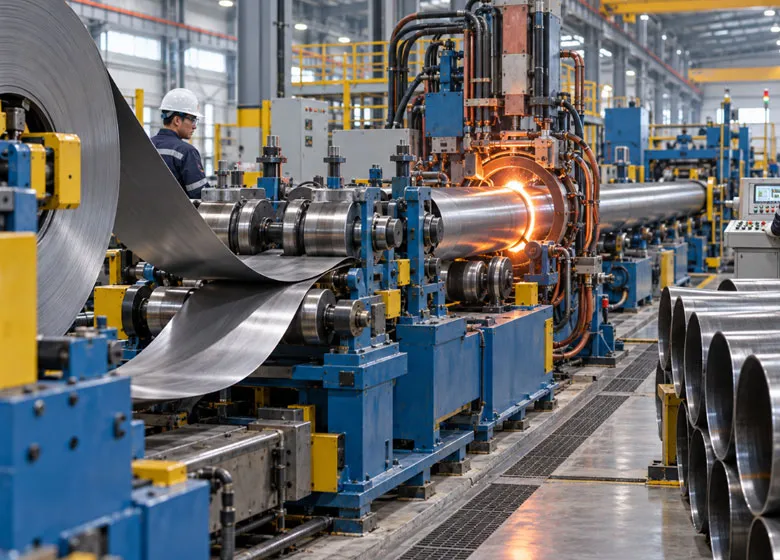
Weld seam control is the management of heat input, edge alignment and forging pressure so the longitudinal seam achieves adequate integrity and consistent mechanical performance.
The weld seam is the most sensitive feature in ERW pipe because it is the area where the steel strip is joined. A well-controlled seam provides reliable performance, while a poorly controlled seam can lead to defects such as lack of fusion, penetrator remnants, hook cracks, edge misalignment or localized hardness issues. In demanding service conditions, even a small seam inconsistency may later affect flattening performance, expansion, hydrostatic pressure resistance or downstream welding behavior.
Good mills therefore focus on repeatability. Edge preparation must be clean and symmetrical. The electrical input must remain stable. Squeeze pressure must be high enough to forge the edges together but not so excessive that it creates dimensional instability or surface damage. Process monitoring is especially important when thickness changes, coil chemistry varies or production is switched between size ranges. Buyers who ask about seam control are not being difficult; they are protecting their own risk.
From a commercial perspective, this is also where supplier communication matters. A credible supplier should be able to explain its control sequence and confirm what seam-related testing is included. When a project has higher inspection expectations, the buyer should request those items explicitly in the RFQ rather than assuming they are part of the standard price.
It is equally useful to ask whether the supplier performs post-weld normalizing or additional heat treatment where applicable, whether the internal bead condition is controlled, and how rejected pieces are segregated. These questions create better visibility into real quality discipline.
Technical inputs are the standard, grade, size and testing requirements that define whether the delivered ERW pipe matches the intended service and project expectations.
Many procurement delays begin with an incomplete inquiry. Before asking for price, the buyer should lock in the key items: standard, steel grade, outside diameter, wall thickness, length, end type, quantity, coating and inspection scope. In some cases, the intended service fluid and design temperature should also be stated. Even when the standard is fixed, grade differences may change chemistry, mechanical requirements or impact test expectations, and those changes affect mill cost and production planning.
It is also useful for purchasing teams to understand api pipe meaning in practical terms. In export business, “API” is often used as a shorthand buying signal, but the relevant requirement may actually be a specific line-pipe or casing-related standard rather than a generic API reference. The clearer the inquiry, the lower the risk of re-quotation and the more reliable the final comparison between suppliers.
As a rule of thumb, the fewer assumptions left open, the faster the project moves. A complete inquiry often reduces back-and-forth communication by more than 30% because mills do not need to clarify the same basics repeatedly. That time saving becomes especially valuable when the order includes mixed sizes or destination-specific documentation requirements.
For example, a buyer who states “ASTM/API equivalent acceptable, bare finish, 6 m random length, plain ends, hydrotest required, MTC required” provides far more usable information than a buyer who only sends size and quantity. The first approach improves quotation speed and conversion quality.
ERW pipe inspection is the combination of visual, dimensional, hydrostatic and non-destructive examinations used to verify the quality of the body and weld seam before shipment.
Inspection normally starts with dimensional verification. Outside diameter, wall thickness, length, straightness, end squareness and ovality are checked against the relevant standard. Visual inspection follows, including surface condition, weld bead finish and end condition. For many applications, these basic checks already eliminate a large share of avoidable quality complaints.
The next layer is non-destructive testing, especially on the weld seam. Ultrasonic testing is one of the most common methods because it can detect internal or subsurface discontinuities without damaging the product. Eddy current testing may also be used in some manufacturing routes. In addition, hydrostatic testing is frequently required to confirm pressure integrity. Depending on the standard and project level, flattening, flaring, bend or drift-related tests may also be specified. The most appropriate package depends on the application. For example, a low-pressure structural use case does not need the same testing emphasis as a fluid service order or a more critical line-pipe supply.
A buyer comparing offers should therefore check not only whether “inspection included” appears on the quotation, but what that phrase actually means. Does it include 100% seam NDT? Does it include hydrotest? Is the material supplied with MTC? Are third-party witness inspections possible? These details determine the true comparability of quotations.
Reliable numbers help here. In many export orders, dimensional checks may be sampled per bundle or per lot, while seam NDT may be performed online on 100% of production length depending on the mill route and standard expectation. Hydrostatic testing is also frequently specified pipe by pipe. These numbers should always be confirmed against the actual supply package rather than assumed.
ERW pipe vs seamless pipe is a procurement comparison between two manufacturing routes that differ in cost structure, dimensional features, availability and use-case suitability.
Buyers often compare ERW with seamless when finalizing a project specification. There is no universal winner because the better choice depends on service, code requirements and budget. However, the comparison is easier when decision points are presented clearly.
| Comparison Point | ERW Pipe | Seamless Pipe |
|---|---|---|
| Manufacturing Route | Formed from coil and longitudinally welded | Pierced and hot-finished or cold-drawn from solid billet |
| Commercial Cost | Usually 10%–25% more cost-efficient in standard sizes, depending on market conditions | Usually higher cost per ton |
| Dimensional Consistency | Strong OD consistency in repeat production | Good overall, often preferred for heavier-wall or critical use |
| Lead Time | Often favorable for production planning in common sizes | Can be longer depending on size and mill route |
| Weld Seam | Has a longitudinal weld seam that must be controlled and tested | No weld seam |
| Common Buyer Use | Water, structural, line pipe, piling, mechanical and general industrial supply | High-pressure, high-temperature, severe service and applications requiring seamless route |
In some projects, the comparison is not about replacing one with the other; it is about using each where it creates the best value. A buyer may source seamless steel pipe manufacturer products for the most demanding service while keeping ERW in the package for secondary or cost-sensitive lines. This mixed strategy is common and commercially efficient.
What matters most is that the buyer compares technically equivalent offers. If one supplier quotes ERW with standard testing and another quotes seamless with expanded inspection, the price difference is not purely a manufacturing-route difference. It is also a testing-package difference.
Size and tolerance details are the measurable dimensions and finishing conditions that directly affect producibility, scrap rate, inspection workload and final price.
Three of the most important commercial variables are outside diameter, wall thickness and order quantity. Small changes in thickness can alter coil selection and yield. Non-standard lengths may increase handling and cutting inefficiency. Tight tolerance requests may require additional process control or sorting. As a result, two inquiries that appear similar can produce noticeably different pricing once those factors are clarified.
Buyers should also define the end finish. Plain ends, beveled ends, threaded ends and special packaging each add a different level of processing. Surface coating is equally important. Bare black pipe is common, but some orders may need varnish, 3PE, galvanizing or shop primer depending on corrosion exposure and project practice. Marking and bundle packing can matter as well, especially for distributor and stockist customers who need easy warehouse identification.
For shipping, a clear packing instruction can reduce damage claims. Bundled pipe with steel straps, end caps where needed, and appropriate weight distribution often performs better during international transport. When mill output is organized this way from the start, export logistics become smoother and unloading at destination is easier for the customer.
Length also changes price perception. Standard 6 m or 12 m lengths may be more competitive than special cut lengths because they reduce cutting loss and handling complexity. A quotation becomes easier to interpret when the buyer clarifies whether fixed length, random length or mixed length is acceptable.
ERW pipe applications are the practical service environments in which welded pipe provides an acceptable balance of strength, availability and cost.
ERW pipe is widely used in line transport, low- to medium-pressure fluid service, piling, scaffolding, structural tubing, water conveyance, mechanical fabrication and a range of industrial systems. In some markets, it is a common choice for fire lines, fencing systems, agricultural irrigation and infrastructure projects. Large-volume municipal or industrial projects often favor ERW because repeat sizes can be produced efficiently and delivered in stable quantities.
In the energy sector, project engineers evaluate whether the selected standard and grade make ERW appropriate for gathering lines, water disposal lines or other service categories. In mechanical applications, consistency of size and good straightness can help downstream fabrication productivity. For distributors, broad applicability also makes ERW attractive because the same inventory family can serve multiple customer groups.
The main commercial lesson is this: the best use case is not defined by the product name alone. It is defined by the combination of service condition, code expectation and buyer risk tolerance. A well-structured inquiry therefore produces a better commercial result than a generic request for “welded pipe price.”
In very practical terms, ERW is frequently attractive where the customer wants balance: dependable availability, manageable cost, adequate performance and a clear route to repeat supply. That balance is exactly why it remains an important product in global pipe trade.
An ERW pipe RFQ is a structured quotation request that gives the mill enough technical and commercial information to issue an accurate offer without repeated clarification.
A strong RFQ should list at least the following items: product description, standard, grade, outside diameter, wall thickness, length, end finish, surface condition or coating, total quantity, destination country, packing method, inspection requirements, documentation and delivery expectation. If a project requires third-party witness inspection, that should be stated at the beginning. If the pipe will be used in a specific environment such as sour service, low-temperature service or structural fabrication, that should also be clarified early.
In practical sourcing work, buyers who provide this information often receive more usable quotations because the supplier can align production route and inspection scope from the start. The quotation can then focus on what matters: price basis, lead time, certificate availability, production capacity and shipping arrangement. That creates a shorter conversion path from inquiry to order confirmation.
A helpful RFQ can even include “must-have” and “nice-to-have” items separately. For instance, hydrotest and MTC may be mandatory, while third-party inspection may be optional. This gives the supplier a better chance to present flexible, conversion-friendly offers.
Supplier support is the ability of a company to convert technical requirements into a clear, traceable and commercially workable supply solution.
For many buyers, the biggest challenge is not finding a pipe product online; it is finding a supplier who communicates clearly enough to prevent expensive misunderstandings. JRSK supports that need by focusing on requirement matching, not just quotation speed. When a customer sends an inquiry, the practical objective is to confirm standard, grade, size matrix, test scope and documentation so that the offer can be reviewed quickly by both the engineering team and the purchasing team.
This matters because a fast but vague quotation rarely closes efficiently. By contrast, a technically aligned offer improves internal customer approval, reduces rework and helps the buyer compare options fairly. Whether the order is for a trial quantity or a larger container-based program, the value of clear communication shows up in fewer delays and better conversion.
For buyers planning mixed procurement, JRSK can also help align ERW supply with other categories such as line pipe, fittings, structural tubulars or seamless products. That type of coordinated purchasing is useful for EPC contractors, stockists and importers who want fewer vendor touchpoints and more consistent documentation control.
From a UX and conversion perspective, this is important because the customer journey becomes simpler: one inquiry, clearer technical alignment, faster quotation review and a more confident buying decision.
FAQs are short direct answers to the buyer questions that most often affect product selection, quotation quality and supply confidence.
In many commercial situations the terms are used very closely together because the seam is produced by electrically generated heat and pressure welding. However, buyers should follow the terminology used in the specific standard and mill documentation.
In standard sizes, ERW is often more cost-competitive than seamless because the manufacturing route is efficient and coil-based production supports higher throughput. The final difference still depends on grade, size, testing and order quantity.
Yes, ERW pipe is widely used for pressure-related applications when the applicable standard, grade and inspection requirements are properly matched to the service condition.
There is no single universal answer, but seam-focused non-destructive testing such as ultrasonic testing is one of the most common and practical controls used in modern production.
At minimum, send the standard, grade, OD, wall thickness, length, quantity, end type, coating requirement, inspection scope and destination country. That usually produces a much more accurate quotation.
Define the technical inputs clearly, confirm included tests in writing, request MTC and marking details, and if the order is critical, consider third-party inspection before shipment.
A conclusion summarizes the practical buying logic that helps readers move from information gathering to confident supplier engagement.
ERW pipe is a commercially important product because it delivers broad application coverage, efficient production and attractive cost performance. Yet the real purchasing outcome depends on more than the word “ERW.” It depends on how well the buyer defines the technical requirement and how well the supplier controls the weld seam, dimensions, inspection and documentation. That is why the best procurement decisions come from a structured approach: understand the process, compare the right technical points, and issue an RFQ that leaves little room for assumption.
If your team is reviewing a welded pipe project, JRSK can help translate the requirement into a practical quotation path and recommend the most suitable specification package. A good ERW inquiry does not just save cost; it reduces project friction, improves approval efficiency and increases the chance of receiving exactly the pipe that the application requires.