English
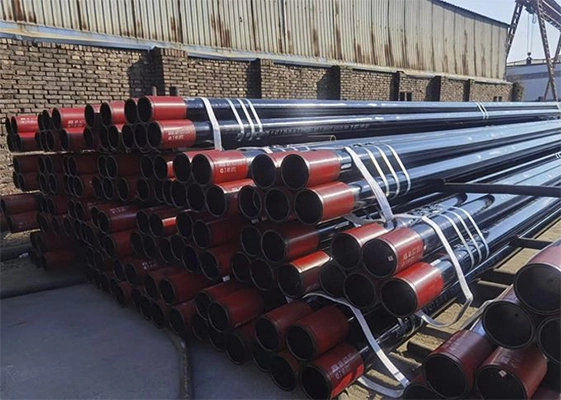
J55 tubing is a widely used OCTG product for conventional oil and gas wells where the required mechanical strength, dimensional configuration, connection performance, and service environment are compatible with the J55 grade. With a minimum specified yield strength of 55,000 psi (379 MPa), J55 provides a practical balance of mechanical performance and cost for many standard production applications.
For oil well construction and production, however, choosing J55 tubing is not simply a matter of selecting a steel grade. Tubing outside diameter, nominal weight, wall thickness, connection type, well depth, internal and external pressure, axial loading, temperature, casing dimensions, completion equipment, and produced-fluid chemistry all influence the final tubing specification.
The most reliable approach is to match the tubing configuration with the actual well conditions. When the grade, dimensions, connection, and service requirements are properly evaluated together, J55 tubing can provide dependable performance throughout conventional production operations.
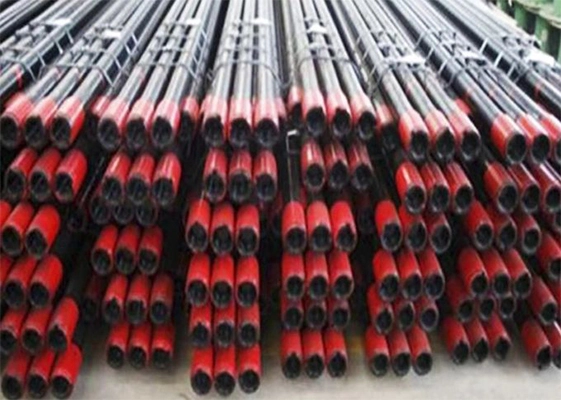
J55 tubing is a steel tubular product designed for use as production tubing in oil and gas wells. In conventional production systems, it serves as a specialized tubing pipe configuration that provides a controlled flow path for produced fluids between the reservoir and the surface production system.
The term "J55" identifies the material grade. It does not define the complete product specification. A complete J55 tubing order must normally identify the tubing outside diameter, nominal weight or wall thickness, connection type, length range, coupling configuration, inspection requirements, and applicable technical standard.
This distinction is important for oilfield procurement. Two products can both be classified as J55 while having different outside diameters, wall thicknesses, connections, and operating characteristics.
API Specification 5CT provides technical delivery requirements for casing, tubing, pup joints, coupling stock, coupling material, and related accessory material. The standard also covers applicable grades, dimensions, masses, wall thicknesses, and end-finish configurations.
For a J55 tubing purchase, buyers should therefore specify the complete configuration rather than simply requesting "J55 tubing." A typical technical specification may include:
Steel grade: J55
Applicable API 5CT requirements
Tubing outside diameter
Nominal weight or wall thickness
Connection type
Length range
Quantity
Coupling requirements
Inspection requirements
Material certification
Heat-number traceability
Marking and packing requirements
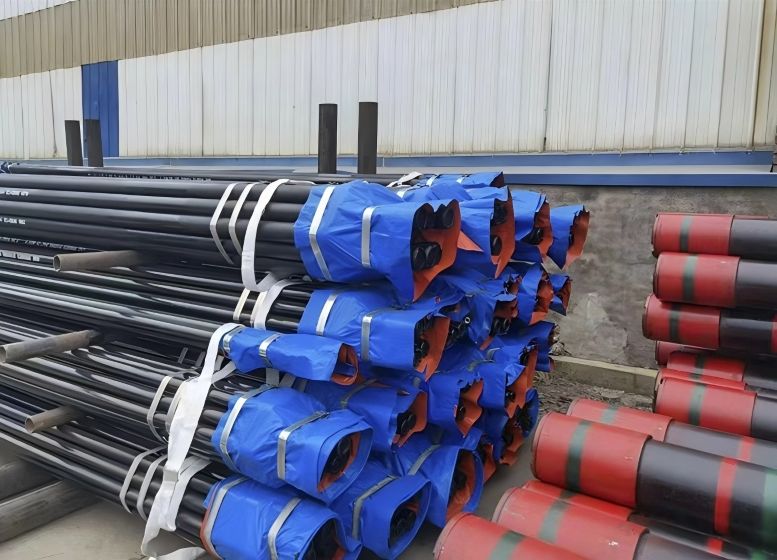
J55 tubing is primarily used as a production string in conventional oil and gas wells where the anticipated mechanical and environmental conditions fall within the appropriate design range.
Its primary function is to provide a controlled passage for reservoir fluids. The tubing is assembled with other completion components to form the production string and extends through the production casing toward the producing interval.
Depending on the completion design, a J55 tubing string may work together with:
Production casing
Tubing couplings
Packers
Pup joints
Downhole safety valves
Gas-lift equipment
Downhole pumps
Sliding sleeves
Wellhead and surface flow-control equipment
The tubing therefore performs both a hydraulic and mechanical function. It must provide an appropriate flow path while carrying its own weight and resisting the pressure and mechanical loads imposed during running, completion, production, and well intervention.
For many conventional wells, J55 offers sufficient strength without the additional material cost associated with higher-strength grades. Nevertheless, the suitability of J55 should always be confirmed through the actual well design rather than assumed from the grade name alone.
J55 tubing specifications are determined by several parameters that work together. Material grade establishes the specified mechanical-property range, while tubing dimensions and connections determine how the product performs as part of the complete production string.
| Specification | Typical J55 Consideration | Why It Matters |
|---|---|---|
| Steel grade | J55 | Defines the specified material-property range |
| Minimum yield strength | 55,000 psi / 379 MPa | Important for mechanical-load evaluation |
| Minimum tensile strength | 75,000 psi / 517 MPa | Important for tensile-load assessment |
| Outside diameter | Project/API specified | Determines casing compatibility and flow area |
| Wall thickness | Project/API specified | Affects pressure and structural performance |
| Nominal weight | Size-dependent | Important for tubing-string weight calculations |
| Connection | NU, EU, IJ, or specified connection | Affects sealing and load transfer |
| Length | Project/API-defined | Determines joint count and installation |
| Coupling | Project specified | Connects individual tubing joints |
| Inspection | API/project requirements | Confirms conformity and traceability |
For international procurement, the purchase order should clearly state all applicable parameters. This reduces ambiguity between the buyer, manufacturer, inspection agency, and logistics provider.
Mechanical properties determine whether J55 tubing can withstand the loads anticipated during installation and production.
| Mechanical Property | J55 Requirement | Engineering Significance |
|---|---|---|
| Minimum yield strength | 55,000 psi / 379 MPa | Important for evaluating yield-related loading |
| Maximum specified yield strength | 80,000 psi / 552 MPa | Defines the specified yield-strength range |
| Minimum tensile strength | 75,000 psi / 517 MPa | Important for tensile-performance evaluation |
These values should not be interpreted as an allowable working-pressure rating.
Actual pressure performance depends on the complete tubing configuration, including outside diameter, wall thickness, pipe condition, connection design, internal pressure, external pressure, axial loading, temperature, and applicable design factors.
For example, a long production tubing string is subjected to significant axial tension because of its own weight. Internal pressure may generate burst-related stresses, while external pressure may become important under specific operating or shut-in conditions. These loads can also interact, meaning that tubing should be evaluated under the combined conditions expected in the well.
J55 tubing is manufactured in standardized oilfield dimensions. Common production tubing outside diameters include 2 3/8 in., 2 7/8 in., and 3 1/2 in., although the available combinations of outside diameter, nominal weight, wall thickness, and connection should always be confirmed against the applicable specification and manufacturer's production range.
| Common Tubing OD | General Selection Consideration | Typical Design Question |
|---|---|---|
| 2 3/8 in. | Compact completion configuration | Is the internal flow area sufficient for the target production rate? |
| 2 7/8 in. | Balance between flow area and completion space | Does it provide adequate flow while maintaining casing clearance? |
| 3 1/2 in. | Larger internal flow area | Can the casing and completion equipment accommodate the larger OD? |
These dimensions are common examples rather than a complete J55 tubing size schedule.
Choosing a tubing diameter involves balancing hydraulic performance against completion geometry. A larger diameter can provide greater flow area and potentially lower frictional pressure losses. However, it also consumes more space inside the casing and may affect the installation of packers, pumps, safety valves, and other completion components.
A smaller tubing size may offer greater clearance but can increase pressure loss at higher flow rates. The appropriate size therefore depends on the actual production target and completion design.
Tubing and casing perform different but closely related functions in an oil well. Casing provides structural support and helps isolate formations, while tubing normally serves as the controlled production flow path.
The tubing must fit inside the casing with sufficient clearance for installation and completion equipment. Casing dimensions therefore have a direct effect on the tubing outside diameter that can be selected.
For a project involving both products, the tubing should be selected according to the internal dimensions, pressure conditions, and completion configuration of the casing pipe in which it will operate.
This relationship is particularly important when the completion includes:
Production packers
Downhole pumps
Gas-lift mandrels
Safety valves
Sliding sleeves
Completion accessories
A tubing specification that appears appropriate when considered independently may not work once the complete completion geometry is taken into account.
Although both products can be manufactured in the J55 grade, tubing and casing have different engineering functions.
| Factor | J55 Tubing | J55 Casing |
|---|---|---|
| Primary function | Production-fluid flow path | Wellbore support and formation isolation |
| Typical position | Inside production casing | Installed as part of the well structure |
| Key design concerns | Flow, pressure, tension and connections | Burst, collapse, tension and formation isolation |
| Connection system | Tubing connections | Casing connections |
| Completion role | Transports produced fluids | Provides the structural envelope |
This difference is important when preparing an OCTG purchase order. Casing and tubing should not be treated as interchangeable simply because they may use the same steel grade.
NU stands for non-upset tubing. In this configuration, the tubing end does not have the external upset associated with an EU configuration.
J55 NU tubing may be selected where the completion design requires the corresponding connection and where the tubing dimensions and mechanical performance are appropriate.
The selection should consider:
Tubing outside diameter
Nominal weight
Connection compatibility
Well depth
Axial loading
Casing clearance
Completion equipment
NU tubing should not be assumed to be interchangeable with EU tubing. The tubing, coupling, connection and completion equipment need to be compatible as a complete system.
EU stands for external upset tubing. The tubing end is externally upset to accommodate the corresponding connection configuration.
EU tubing may be selected when the completion system requires this connection type and the resulting dimensions and mechanical characteristics satisfy the project requirements.
| Feature | J55 NU Tubing | J55 EU Tubing |
|---|---|---|
| Meaning | Non-upset tubing | External upset tubing |
| End configuration | Non-upset | Externally upset |
| Connection | NU | EU |
| Selection basis | Completion and dimensional requirements | Completion, connection and loading requirements |
| Interchangeability | Must be confirmed against the applicable specification | |
API 5CT recognizes non-upset tubing, external upset tubing, and integral tubing among the applicable tubing connection configurations. The actual connection should be specified according to the project requirements.
J55 tubing is suitable for a range of conventional applications when the well conditions remain within the grade's appropriate design envelope.
J55 is commonly considered for conventional oil wells where calculated tensile, pressure, and combined loading requirements can be satisfied by the grade.
Selected gas wells can also use J55 tubing when pressure, temperature, corrosion, and connection requirements are appropriately evaluated.
J55 tubing can be incorporated into completion systems containing packers, pumps, safety valves, gas-lift equipment, and other components where the dimensional and connection requirements are compatible.
Where engineering calculations demonstrate that J55 provides adequate mechanical capacity, it can be an economical alternative to higher-strength grades that are not necessary for the application.
The objective is not to select the strongest possible tubing. It is to select a tubing grade that provides the required performance with an appropriate design margin.
J55 tubing selection should start with the well conditions rather than the product catalog.
The target production rate affects the required tubing flow area. A tubing string that is too small can increase frictional pressure losses and restrict production performance.
Fluid viscosity, gas-liquid ratio, density, temperature, pressure, and expected production behavior should also be considered when evaluating the required internal diameter.
As well depth increases, the weight of the tubing string becomes more significant. Axial loading should be evaluated during both running and production conditions.
The tubing should be evaluated against the expected internal and external pressure envelope. Burst and collapse considerations are influenced by tubing geometry and loading conditions rather than material grade alone.
The tubing OD must fit inside the production casing while leaving sufficient clearance for running and completion equipment.
NU, EU, IJ, or another specified connection should be selected according to the completion design and applicable technical requirements.
Produced fluids may contain water, chlorides, carbon dioxide, hydrogen sulfide, and other constituents that can influence corrosion and material performance.
If the well uses a downhole pump, gas lift, or another artificial-lift method, tubing dimensions must be compatible with the selected equipment.
Inspection requirements should be agreed before production. This may include dimensional inspection, mechanical testing, thread inspection, non-destructive examination where specified, heat-number traceability, and material certification.
A structured selection process significantly reduces the risk of purchasing a tubing configuration that is technically correct in isolation but unsuitable for the complete well system.
J55, N80, and P110 represent different API 5CT steel grades with different minimum specified yield strengths.
| Grade | Minimum Specified Yield Strength | General Application Consideration |
|---|---|---|
| J55 | 55 ksi / 379 MPa | Conventional applications with moderate strength requirements |
| N80 | 80 ksi / 552 MPa | Applications requiring higher yield strength |
| P110 | 110 ksi / 758 MPa | Applications requiring substantially higher mechanical capacity |
A higher-strength tubing grade is not automatically a better solution.
If the calculated well loads remain within the appropriate J55 design range, upgrading to N80 or P110 may increase material cost without providing a necessary operational benefit.
Conversely, if well depth, axial loading, pressure, temperature, or other design conditions exceed the appropriate J55 capability, a higher-strength grade may need to be evaluated.
The correct selection is therefore determined by the engineering requirements of the well rather than by the maximum available material strength.
J55 tubing can be used in a high-pressure environment only when the specific tubing configuration has been demonstrated to satisfy the applicable engineering requirements.
There is no single universal working-pressure rating for all J55 tubing. Pressure capability depends on several variables, including:
Outside diameter
Wall thickness
Pipe condition
Connection design
Internal pressure
External pressure
Axial loading
Temperature
Design factors
A common procurement mistake is to interpret the 55,000 psi yield strength of J55 as its allowable operating pressure. Yield strength and working pressure are different engineering concepts.
The allowable pressure must be determined from the actual tubing dimensions, material properties, connection performance, loading conditions, and applicable design methodology.
Sour-service applications require additional material evaluation because hydrogen sulfide can create cracking and other integrity risks in oilfield tubulars.
J55 should not automatically be considered suitable for sour service simply because it conforms to API 5CT. The actual environmental conditions and applicable sour-service requirements must be reviewed.
Important factors include:
H2S concentration
Pressure
Temperature
Water chemistry
Chloride concentration
Exposure conditions
Applicable sour-service requirements
Required testing and material qualification
Where severe sour conditions exist, the engineering team may need to evaluate alternative grades, corrosion-resistant materials, or additional service-specific requirements.
The connection is one of the most critical parts of a tubing string. Individual joints must be connected into a continuous production string capable of carrying mechanical loads while maintaining the required sealing performance.
Connection integrity can be affected by:
Thread geometry
Thread condition
Coupling dimensions
Make-up torque
Thread compound
Contamination
Handling damage
Running procedures
A tubing body can satisfy the required material properties while the overall string still fails to meet the project requirements if the connection configuration is incorrect or improperly handled.
For this reason, buyers should specify the connection type clearly in the RFQ and purchase order instead of requesting only J55 grade and tubing diameter.
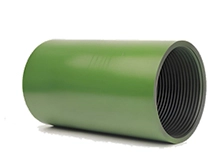
Couplings connect individual tubing joints to create the continuous production string. The coupling must match the tubing size, grade, connection configuration, and applicable technical requirements.
For new tubing strings, replacement joints, or workover projects, the appropriate tubing coupling should be considered as part of the complete tubing package.
Buyers should verify:
Coupling size
Connection type
Material grade
Thread configuration
Quantity
Inspection requirements
Traceability requirements
Because the coupling participates directly in the tubing-string connection, it should be evaluated as an integral component rather than as a separate accessory.
Inspection should confirm that the finished product conforms to the applicable API requirements and the buyer's purchase specification.
Depending on the project, inspection may include:
Chemical composition verification
Yield-strength testing
Tensile-strength testing
Elongation verification
Outside-diameter measurement
Wall-thickness measurement
Length measurement
Visual inspection
Thread inspection
Drift inspection
Non-destructive examination where specified
Coupling inspection
Heat-number traceability
Product marking verification
For international OCTG projects, documentation is also an important part of quality assurance. Depending on the contract, buyers may request material certificates, inspection reports, dimensional reports, heat-number records, third-party inspection reports, packing lists, and product-marking records.
J55 identifies the material grade, but it does not define the complete tubing configuration. Outside diameter, wall thickness, nominal weight, connection, length, and inspection requirements must also be established.
The tubing must fit inside the production casing together with the required completion equipment. Selecting a diameter without checking the casing geometry can create installation problems.
Yield strength is a material property, not a universal allowable operating pressure. Pressure performance must be evaluated using the complete tubing configuration and expected loads.
Higher strength can be valuable when the well requires it, but it does not automatically provide better economics or performance when J55 already satisfies the engineering requirements.
The tubing connection is part of the production system and should be selected together with the tubing body and coupling.
Corrosion, H2S, CO2, chlorides, water content, and temperature can influence material selection and service life.
Unit price should not be the only purchasing criterion. Product conformity, inspection, documentation, traceability, packaging, connection quality, delivery reliability, and technical communication can all influence total project cost.
A technically complete RFQ allows manufacturers to quote the correct configuration and makes supplier comparison more transparent.
| RFQ Item | Information to Provide |
|---|---|
| Product | J55 tubing |
| Standard | Applicable API 5CT requirements |
| Grade | J55 |
| Outside diameter | Required tubing OD |
| Nominal weight / wall thickness | Required value |
| Connection | NU, EU, IJ, or specified connection |
| Length | Required length range |
| Quantity | Number of joints or total length |
| Couplings | Quantity and connection configuration |
| Inspection | API, third-party, or project requirements |
| Documentation | Material certificates, inspection and traceability records |
| Packing | Export or project-specific requirements |
| Destination | Port or final delivery location |
For technically demanding projects, the RFQ should also provide well depth, expected production rate, internal pressure, external pressure, temperature, fluid chemistry, casing dimensions, completion type, and artificial-lift requirements where available.
JRSK focuses on OCTG products for oilfield applications and supports customers requiring tubing, casing, couplings, and related steel tubular products.
For a J55 tubing project, the procurement process should begin with the actual well requirements. Once the grade, dimensions, connection, length, inspection criteria, documentation, and delivery requirements are established, the supplier can confirm the appropriate product configuration.
JRSK's product offering allows buyers to coordinate J55 tubing with other OCTG components, helping ensure that tubing dimensions and connections are considered alongside the casing and completion system.
This integrated approach can be particularly useful for international projects where buyers need consistent technical documentation, inspection coordination, packaging, and shipment arrangements across multiple OCTG products.
For customers preparing an inquiry, providing the required tubing OD, nominal weight, connection, quantity, length, applicable standard, inspection requirements, and delivery destination at the quotation stage can make technical evaluation and commercial communication considerably more efficient.
Before placing an order, buyers should confirm the following:
Is J55 appropriate for the calculated mechanical loads?
What tubing outside diameter is required?
What nominal weight or wall thickness is required?
Is NU, EU, IJ, or another connection required?
What is the well depth?
What internal pressure is expected?
What external pressure needs to be considered?
What axial loads will the tubing experience?
What operating temperature is expected?
What fluids will contact the tubing?
Are H2S or CO2 concerns present?
What casing dimensions are available?
Which completion components must the tubing accommodate?
Are couplings included in the order?
What inspection level is required?
What material certificates and traceability documents are required?
What packing and delivery requirements apply?
J55 tubing is primarily used as production tubing in conventional oil and gas wells. It provides the flow path for produced fluids inside the production casing and can be integrated with packers, pumps, valves, gas-lift equipment, and other completion components.
J55 has a minimum specified yield strength of 55,000 psi, or approximately 379 MPa. Its minimum specified tensile strength is 75,000 psi, or approximately 517 MPa, subject to the applicable API requirements.
Common tubing outside diameters include 2 3/8 in., 2 7/8 in., and 3 1/2 in. The exact combination of OD, nominal weight, wall thickness, and connection should be confirmed against the applicable specification and manufacturer's product range.
NU means non-upset tubing, while EU means external upset tubing. The two configurations have different tubing-end geometries and connection arrangements. The correct option depends on the completion design, dimensions, loading conditions, and applicable technical requirements.
J55 can be considered for some deep-well applications when the calculated mechanical loads remain within the appropriate design range. Well depth alone does not determine suitability; tubing weight, axial loading, pressure, temperature, connection performance, and design factors must also be evaluated.
Start with the well depth, production rate, pressure, temperature, casing dimensions, fluid chemistry, completion configuration, and expected loading conditions. Then specify the appropriate J55 tubing OD, nominal weight or wall thickness, connection, length, coupling configuration, inspection requirements, and documentation.
J55 tubing remains a practical OCTG solution for many conventional oil well construction and production applications when its mechanical properties and service characteristics match the actual operating conditions.
The key point for buyers is that J55 is a steel grade rather than a complete tubing specification. Reliable selection requires the grade to be considered together with tubing dimensions, wall thickness, nominal weight, connection type, length, pressure conditions, axial loading, casing compatibility, temperature, fluid chemistry, and completion equipment.
For conventional wells where J55 provides sufficient mechanical capacity, it can offer an effective balance between performance and procurement cost. Where a well involves higher mechanical loads, severe pressure conditions, or challenging service environments, a higher-strength or more specialized material may need to be evaluated.
For international OCTG buyers, the most effective procurement strategy is to provide a complete technical specification rather than requesting "J55 tubing" alone. With clear requirements, suppliers such as JRSK can better confirm the appropriate tubing configuration, connection, inspection level, documentation, and related OCTG products for the project.
https://www.api.org/products-and-services/standards/important-standards-announcements/spec5ct
https://www.api.org/products-and-services/standards/standards-plan

This is the last one.