English
In OCTG procurement, many supply issues do not start with steel grade or price. They start with a connection mismatch. A buyer may confirm the casing size, wall thickness and material grade, yet still face a field problem because the thread type, coupling style or make-up expectation was not properly aligned at the quotation stage. For oilfield tubulars, the connection is more than a detail. It affects sealing behavior, running efficiency, mechanical performance, replacement compatibility and ultimately the success of the job.
This is why connection terminology matters. Terms such as STC, LTC, BTC, EUE and NUE are used every day in quotations, thread shop communication and customer specifications, but not every buyer interprets them with the same level of precision. Some buyers need a fast refresher before confirming an order. Others are training new procurement staff. Still others are comparing multiple suppliers and want to be sure the quoted connection actually matches their requirement.
This article is written to solve that problem in a practical way. It explains the most common API-style connection types for casing and tubing, the difference between casing and tubing thread families, the basic logic of connection selection, the inspection points buyers should review, and the commercial questions that improve quotation quality. The article is also structured with clear definition-led sections so that the content is easier to cite, easier to skim and easier for AI tools and search engines to understand.
OCTG connection types are the threaded end designs and matching couplings used to join oil country tubular goods such as casing and tubing in drilling and production operations.
OCTG stands for oil country tubular goods, a family that commonly includes casing, tubing and drill pipe. In field operations, the connection determines how individual pipe lengths are made up into a string. It must provide mechanical continuity, support running operations and, depending on the design, help maintain pressure integrity. In practical commercial terms, a connection type tells the supplier what end threading, coupling style and compatibility requirement the product must meet.
For buyers, connection types are essential because a product description that only states size and grade is incomplete. A quotation for 2-7/8 inch tubing, for example, is not fully actionable unless the threading and coupling requirement are also clear. The same logic applies to casing. Without the correct connection definition, the order may not match the existing inventory, the field tools or the running practice used by the customer.
The most commonly discussed API-style terms in commercial supply are STC, LTC and BTC for casing, and EUE and NUE for tubing. Each serves a different use logic, and understanding that logic reduces both technical and commercial risk.
The difference between casing and tubing connections is that casing threads are selected primarily for running and structural string performance, while tubing threads are selected primarily for production string service and compatibility.
Casing and tubing belong to the same OCTG family, but they do not play the same role in the well. Casing is typically used to line the wellbore and provide structural stability. Tubing is the pipe string through which production fluids are brought to the surface. Because the service logic differs, the connection families also differ. Buyers handling casing and tubing should therefore avoid assuming that one connection naming system can be used interchangeably for both products.
In commercial supply, casing is often quoted with short thread coupling, long thread coupling or buttress thread coupling. Tubing is commonly quoted with EUE or NUE ends. The practical questions are straightforward: what equipment is already in the field, what does the string design call for, which accessories must match, and what is the operator or contractor already accustomed to using? When those questions are answered early, supplier communication becomes much more efficient.
For procurement teams, this distinction also improves inventory control. Warehousing the correct connection family reduces the chance of issuing a product that is dimensionally correct but operationally unusable. That is especially important for distributors and multi-country projects.
Because wells often contain multiple tubular categories, incorrect connection labeling can also create downstream confusion in the yard. Strong warehouse discipline and clear supplier marking help avoid that problem.
STC means short thread coupling, a common casing connection style that uses a comparatively shorter threaded engagement and a separate coupling.
STC is widely used because it is familiar, serviceable and commercially accessible. In practical supply work, buyers often choose STC for general casing applications where interchangeability and standard field familiarity are important. Because it uses a coupling, the pin ends of the pipe are connected through a separate threaded sleeve. This makes inventory recognition and field handling relatively straightforward.
The buyer advantage of STC is commercial simplicity. It is commonly available, well understood across many supply chains and easier to compare between offers when the rest of the specification is fixed. The buyer should still confirm size range, grade, finish and thread protector requirements, but STC usually does not create the same level of confusion as less familiar or premium connections. That said, “easy to source” should not be confused with “no need to verify.” Thread quality, coupling supply and dimensional compatibility still matter.
Where a project requires a standard casing connection and does not specify a different performance need, STC is often part of the supplier discussion. However, the final decision should always follow the application, not habit alone.
In tender practice, one useful habit is to list STC explicitly in the line-item description rather than only in a comment column. That improves internal review clarity.
LTC means long thread coupling, a casing connection design with a longer thread engagement than STC and a separate coupling.
LTC is selected when the project or end user prefers a longer engaged connection geometry. Buyers may encounter LTC when matching existing string design, customer drawing requirements or wellsite practice. The “long thread” concept is commercial shorthand, but what matters to the buyer is that the supplied product must match the specified thread form and coupling requirement exactly.
Compared with STC, LTC is not simply “better” or “stronger” in every circumstance. It is different, and suitability depends on the well design, operator preference and compatibility expectation. This is an important point because many international buyers compare quotations from multiple mills and may see different assumptions. One offer may list a casing item generically, while another may specify LTC clearly. The buyer should always normalize the comparison before making a price decision.
For projects with replacement or compatibility concerns, confirming LTC early can prevent costly rework. A delayed connection clarification can disrupt not only pipe supply, but also the sourcing of couplings, protectors and other associated items.
For aftermarket or maintenance supply, LTC clarity is especially important because even a small connection mismatch can make replacement stock difficult to use in the field.
BTC means buttress thread coupling, a casing connection style known for its distinctive thread profile and frequent use in many casing programs.
BTC is one of the connection terms that procurement teams often recognize quickly because it appears frequently in international casing quotations. It is associated with a buttress-style thread form designed for casing service. In practical purchasing, BTC may be preferred when project documents call for it explicitly or when the user wants the compatibility of a recognized casing thread family.
The important buyer lesson is not to reduce BTC to a buzzword. A correct BTC supply package still requires confirmation of grade, size, coupling, pipe body specification and inspection expectations. Buyers should also verify whether accessories or field tools must match a specific thread family. When multiple vendors participate in a tender, making BTC explicit in the technical tabulation can improve bid comparability significantly.
Because casing orders are often bundled with other OCTG products, BTC communication should be tied to the full supply package. That includes protectors, marking, thread compound handling requirements where applicable and shipping arrangements that minimize thread damage in transit.
Another practical point is that BTC-related orders often involve larger program quantities, so consistency across batches matters just as much as first-article conformity.
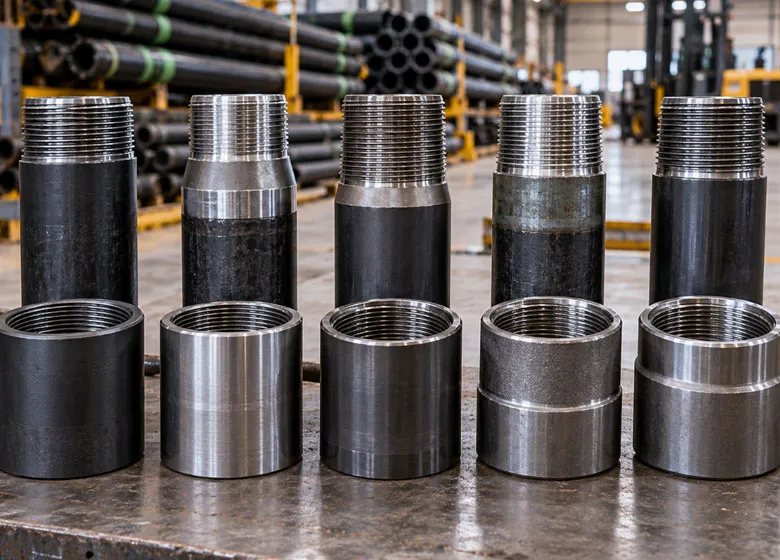
EUE and NUE are common tubing connection types, with EUE referring to external upset ends and NUE referring to non-upset ends.
These two terms are fundamental in oil tubing procurement. In simple terms, EUE tubing has upset pipe ends, which changes the end geometry before threading, while NUE tubing uses non-upset ends. The difference affects compatibility, dimensions at the threaded area and buyer selection practice. Because both connection types remain common in the market, tubing quotations should never assume one when the inquiry is silent.
Commercially, EUE and NUE also affect the accessories and couplings that belong to the supply package. Buyers should confirm whether the tubing is intended to match existing field inventory or a new program design. If an end user operates both connection types across different assets, the purchasing team should document the required connection very clearly at PO stage to avoid warehouse issuance errors later.
For stockists and distributors, connection clarity is even more valuable. Tubing products may look similar at a glance, but wrong connection allocation can create immediate downstream problems. Good labeling, end protection and bundle identification are therefore not small details; they protect order accuracy and customer trust.
Since tubing strings may be handled repeatedly during service life, surface condition at the threaded area and protector quality also deserve extra attention.
Comparing OCTG connection types means reviewing their product family, typical commercial use and key buyer checkpoints side by side.
| Connection Type | Product Family | General Commercial Role | Main Buyer Checkpoint |
|---|---|---|---|
| STC | Casing | Common standard casing connection | Confirm thread type, coupling supply and field compatibility |
| LTC | Casing | Long-thread casing connection | Match existing specification or string design |
| BTC | Casing | Buttress casing connection | Verify accessories and bid comparability |
| EUE | Tubing | External upset tubing connection | Confirm coupling, upset requirement and service practice |
| NUE | Tubing | Non-upset tubing connection | Confirm compatibility with inventory and intended completion practice |
This comparison is useful because it converts terminology into procurement action. Buyers do not need to memorize every technical drawing to improve order accuracy. They need to know which family they are buying, which field expectation it serves and which compatibility points they must confirm before the order is released.
Reliable numbers can also support internal discussion. For example, many casing and tubing orders are delivered in lengths that fall into common range groupings, while every pipe section must still be compatible with the selected connection family. This is why count, range and connection should always be reviewed together.
Definition: Thread quality and coupling quality are the manufacturing accuracy and surface condition factors that determine whether OCTG connections can be made up smoothly and reliably.
Even when the correct connection type is chosen, the order can still fail commercially if thread quality is inconsistent. Damaged thread crests, poor gauging, inadequate protection during transport or low-quality couplings can create running problems, leakage risk, or rejection at site. For this reason, buyers should not focus only on pipe body properties. The connection package is a quality package.
Good procurement practice includes confirming thread inspection, gauging method, coupling availability and protector arrangement. If the order will be exported over a long distance, robust thread protectors become particularly important. A high-value OCTG order can lose site confidence very quickly if connections arrive damaged. From a conversion perspective, this is also where supplier professionalism matters: clear inspection records and organized packing help the customer approve the shipment more confidently.
In practice, even a single damaged thread end can slow a running operation because it triggers inspection, replacement or field rework. Preventing that loss of time is part of the value of careful supplier selection.
Definition: An OCTG connection RFQ is a quotation request that defines the pipe body and the thread/coupling package clearly enough for the supplier to issue a technically correct offer.
A strong RFQ should identify the product as casing or tubing, state the size, wall thickness or weight, grade, length range, connection type, coupling requirement, thread protector requirement, inspection scope, documentation need and quantity. If the order must match an existing field program, that should be stated explicitly. If a customer drawing or approved vendor list exists, that information should also be attached early.
Many buyers also benefit from noting whether they expect complete supply from a casing pipe manufacturer perspective or whether they are only sourcing part of the package. For example, some buyers need pipe and couplings together, while others already hold couplings in stock and only need matching threaded pipe. That difference can change both quotation logic and lead time.
In large tenders, a structured RFQ often shortens review time by several days because engineering and procurement can evaluate the same technical checklist. That clarity improves the chance of faster internal approval and quicker order conversion.
Adding shipment destination, requested packing mode and documentation language can make the RFQ even better. These items seem administrative, but they often affect export readiness.
Reducing OCTG connection risk means preventing mismatches, thread damage and quoting ambiguity before the order reaches the field.
JRSK supports buyers by focusing on the exact points that often create confusion in OCTG business: casing vs tubing distinction, connection confirmation, coupling scope, protector arrangement and shipment readiness. In practical terms, this means helping the customer convert a broad inquiry into a technically aligned quotation that is easier to approve internally and safer to execute.
For repeat buyers, the value is consistency. For first-time buyers, the value is clarity. In both cases, the goal is the same: fewer assumptions, fewer re-quotations and fewer surprises at receipt or site use. When an OCTG order includes multiple items, coordinated review of the full package also helps ensure that related accessories and documentation stay aligned.
From a conversion perspective, this means customers spend less time revalidating the basics and more time moving toward a confident purchase decision. Better clarity improves both trust and sales efficiency.
Common buying mistakes are the avoidable specification, packaging and documentation errors that lead to mismatched OCTG supply or field delays.
One of the most common mistakes is describing the pipe body clearly while leaving the connection description vague. A buyer may specify size, weight and grade correctly, yet still create risk by omitting STC, LTC, BTC, EUE or NUE from the line item. Another frequent mistake is assuming couplings are automatically included. In some quotations they are, and in others they are not. Unless the RFQ and quotation both state the coupling scope clearly, the customer may think the package is complete when it is only partial.
A third mistake is underestimating packing and protection. OCTG is not ordinary structural pipe. Threaded ends need proper protectors, clean handling and disciplined loading. Damage during transport can convert a technically correct order into a practical problem at destination. Buyers should also avoid mixing connection terminology between casing and tubing, especially when multiple product families are purchased together. Finally, document control should not be left to the end. Thread inspection records, marking logic, MTC references and export packing details all support smoother receiving and easier internal approval.
In short, the best prevention strategy is simple: define the connection precisely, confirm accessories explicitly, protect threads correctly and make documentation part of the buying plan. These steps reduce risk, speed up communication and create a more conversion-friendly procurement process.
Definition: FAQs provide short practical answers to the connection questions buyers ask most often before finalizing casing and tubing orders.
Yes, they are commonly used casing connection terms in OCTG supply and should be specified clearly whenever casing is quoted.
Yes. EUE and NUE are standard commercial terms used in tubing procurement, and the chosen type must match the field requirement or existing inventory.
No. Without a clear connection type, quotations may not be technically equivalent, so any price comparison may be misleading.
Thread protectors help prevent connection damage during storage, loading, ocean transport and unloading. They are especially important for export supply.
Yes, if the project requires them separately or if the buyer needs clarity on whether the quoted price includes couplings. This avoids a common source of supply misunderstanding.
State whether the product is casing or tubing, confirm size and grade, define the connection type, note coupling and protector requirements, and attach any matching or field compatibility instructions.
A conclusion restates the buying logic that helps customers turn connection terminology into correct purchasing decisions.
OCTG connection types are not minor labels; they are essential technical and commercial identifiers for casing and tubing supply. STC, LTC and BTC guide casing procurement. EUE and NUE guide tubing procurement. When those terms are understood and specified correctly, buyers reduce mismatch risk, improve quotation accuracy and build a smoother path from inquiry to field use.
For companies that buy OCTG internationally, the best practice is straightforward: confirm the product family, confirm the connection family, confirm whether couplings and protectors are included, and make thread quality part of the supplier discussion. JRSK can support that process by helping customers turn technical intent into a clear and workable quotation package that is easier to approve and easier to execute.
Outbound Links