English
Many purchasing delays in the steel pipe business happen for a simple reason: the inquiry is too broad. A buyer asks for seamless carbon steel pipe, but the standard, grade, schedule, end finish, testing requirement or documentation package has not been defined clearly enough to support a reliable quotation. The supplier then has to guess, or return with a list of questions, and the sourcing cycle becomes slower, less comparable and more difficult for the customer to approve internally.
This article is designed to solve that problem. It explains how to build a clear RFQ for seamless carbon steel pipe so that procurement teams can receive more accurate offers, compare suppliers more fairly and reduce the risk of receiving material that does not match the intended application. The content is especially useful for importers, EPC buyers, project contractors, stockists and industrial purchasing teams that work with mixed standards and multiple end-use scenarios.
Rather than repeating generic product descriptions, the guide focuses on practical selection logic: when to choose one standard over another, how grade and schedule change the commercial outcome, which tests should be stated explicitly, what an MTC should support, and how to organize a quotation request so that suppliers can respond efficiently. As with the other articles in this series, each section starts with a concise definition sentence to improve clarity for readers and for AI citation environments.
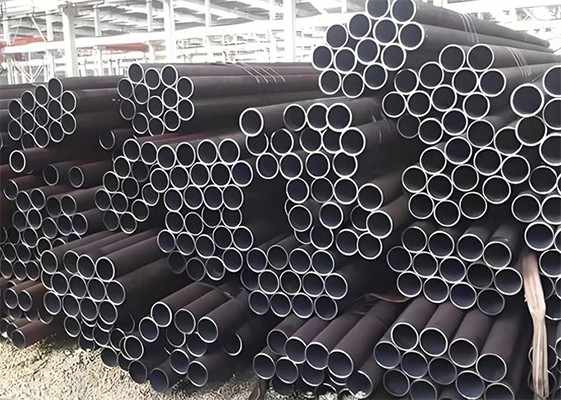
Seamless carbon steel pipe is a steel pipe made from a solid billet through piercing and rolling or drawing, resulting in a pipe body without a longitudinal weld seam.
From a procurement viewpoint, the absence of a weld seam is the first major distinguishing feature. Buyers choose seamless carbon steel pipe for many reasons: pressure service, elevated-temperature service, lower-temperature applications, project specifications, fabrication preference or customer habit. The product is common in energy, petrochemical, boiler, mechanical, line pipe, structural and general industrial supply chains.
The term itself, however, is still too broad for quotation. A meaningful RFQ must move beyond the product family and define the manufacturing and inspection expectation in a commercially workable way. Not all seamless carbon steel pipe serves the same purpose. Pipe for pressure service is not automatically the same as pipe for low-temperature service, boiler service or line-pipe service. This is why the RFQ should translate the application into the correct standard and grade rather than stopping at a generic description.
For customers, this clarity reduces two common problems: pricing that cannot be compared fairly between suppliers and post-order clarification that slows production planning. Both issues can be reduced significantly when the specification is structured correctly at the inquiry stage.
Because seamless pipe can serve multiple industries, an RFQ that identifies the actual service scenario creates immediate value. It helps the mill understand whether the order is routine stock supply or project-critical material.
Standard selection is the process of choosing the governing specification that defines chemistry, mechanical properties, testing and dimensional rules for the intended service.
The standard is often the first item a supplier looks for because it determines the technical framework of the offer. Different standards exist for different service conditions. Some are used for general or pressure service, some for line pipe, some for low-temperature duty and others for heat-transfer or boiler-related applications. If the RFQ omits the standard, the supplier may not know which mechanical properties, impact tests or inspection requirements to assume.
In practical procurement, buyers often evaluate seamless pipe under commonly recognized frameworks such as pressure-pipe standards, line-pipe standards or low-temperature service standards. The most important lesson is not to memorize every specification by heart, but to connect the application to the correct standard family. Doing so improves pricing accuracy and reduces the chance of ordering material that is technically usable in one context but commercially unsuitable in another.
For mixed projects, the standard choice also helps internal approval. Engineering teams and purchasing teams can align more quickly when the inquiry already reflects the service intent. That reduces decision time and improves the probability of receiving a first-round quotation that can move toward order confirmation.
It also helps prevent an expensive but common mistake: comparing quotations that are not actually based on the same standard logic. A lower price is not useful if the standard family is wrong for the job.

Grade selection is the choice of the steel material level within the selected standard, based on strength, service condition and project requirement.
Once the standard is fixed, the grade becomes the next critical decision. Grade selection is not only about strength. It can also influence chemistry limits, impact requirement, heat treatment expectation and price. A supplier cannot meaningfully confirm supply unless the grade is known, because one standard may contain several grade options with different commercial implications.
For buyers, the safest approach is to connect grade selection with the end use. If the application involves higher pressure, lower temperature, fabrication constraints or customer-mandated documentation, the grade should be chosen with those conditions in mind. Where the end customer or engineering team already specifies the grade, the procurement task becomes easier: the RFQ simply needs to carry that grade through consistently across the quotation comparison.
If the buyer is still evaluating options, it is often useful to ask the supplier to quote based on one required grade and one acceptable alternative. This can reveal cost and lead-time differences without creating confusion. In other words, grade choice can also be used as a sourcing strategy tool, not only as a technical label.
From a sales-conversion angle, suppliers appreciate this clarity because it shortens technical clarification and lets them answer with more confidence. Buyers appreciate it because internal review becomes simpler.
Size and schedule define the outside diameter and wall thickness of the pipe, which directly influence pressure capability, weight, fabrication behavior and final price.
Buyers often underestimate how much schedule affects the quotation outcome. A small change in wall thickness can alter raw material consumption, mill route availability, weight per meter and shipping cost. When combined with length requirements, it can also influence bundle packing and export logistics. This is why the RFQ should always identify diameter and schedule or wall thickness clearly, not just nominal size alone.
Size also affects application suitability. Smaller-diameter precision-oriented requirements may involve a different supply approach than larger-diameter industrial piping projects. In most RFQs, the supplier needs either exact nominal size plus schedule or exact OD plus wall thickness. When buyers provide both, quotation errors are less likely. Where the order includes a matrix of sizes, a structured table is highly recommended because it reduces manual interpretation errors and helps the supplier confirm quantity and tonnage more accurately.
In international trade, accurate size information also helps with freight planning. Weight and volume calculations become more reliable, which improves the commercial usefulness of the supplier’s offer.
Reliable numbers are particularly helpful here. Weight per meter, total tonnage, bundle count and container loading estimate all change with schedule, so even small errors can affect the budget.
End finish, length and surface details are the processing and delivery conditions that affect how the pipe is fabricated, installed, protected and priced.
Many RFQs focus on material standard and forget the processing details. Yet end finish can have a direct impact on whether the material is immediately usable. Common needs include plain ends, beveled ends, threaded ends, caps and special packing. If the pipe will go directly into field welding, bevel details may matter. If the customer is buying stock material, plain ends may be more appropriate. These choices should not be left to assumption.
Length is equally important. Standard commercial lengths are often more economical than special cut lengths, but project-based buyers may need exact cut lengths for fabrication efficiency. Surface condition should also be addressed. Bare pipe, varnish-coated pipe, black finish and special preservation treatments may all change the supply package. If the project is in a corrosive environment or the transport route is long, stating the surface protection requirement clearly can prevent avoidable delivery complaints.
These are not “small details.” In many international orders, they determine whether the quotation is truly ready for customer approval or still incomplete.
Another overlooked point is marking. If the customer needs heat number traceability on each length or each bundle, the RFQ should say so. That requirement can affect handling and packing.
Comparing standards means reviewing common service intent and buyer checkpoints so that the RFQ matches the final application more accurately.
| Standard Family | Typical Service Intent | Main Buyer Focus |
|---|---|---|
| ASTM A53 / similar general pipe frameworks | General service and common industrial piping | Confirm service condition and whether seamless route is required |
| ASTM A106 / similar pressure pipe frameworks | Pressure and elevated-temperature service | Confirm grade, testing and fabrication requirements |
| ASTM A333 / similar low-temperature frameworks | Low-temperature service | Confirm impact or low-temperature expectation and grade |
| API 5L / line-pipe frameworks | Pipeline and line transport service | Confirm PSL level, end finish and project documentation needs |
| Boiler / heat-transfer standards | Boiler, superheater or heat exchanger use | Confirm whether a dedicated boiler/tube specification is more appropriate |
This table is intentionally practical. It does not replace the standard text. Instead, it helps buyers ask the right question: does the service intent of the project align with the selected standard? That single question prevents many quotation mistakes.
For example, if the application is actually more aligned with seamless boiler tubes than with general pipe, the buyer should not force a generic carbon pipe description onto the inquiry. The more accurately the product family is named, the more useful the supplier’s quotation will be.
This section also shows why article structure matters for SEO and GEO. Buyers searching “standard vs grade for seamless carbon steel pipe” often need a comparison table first and detailed explanation second. Clear structure improves both readability and citation potential.
Testing requirements are the examinations that prove the supplied pipe meets the dimensional, mechanical and quality expectations of the order.
Testing is one of the most frequent areas of commercial misunderstanding. Suppliers may assume the standard test package, while buyers may expect additional examinations without stating them explicitly. To avoid that mismatch, the RFQ should list the required test scope clearly. This may include chemical analysis confirmation, tensile testing, hardness-related checks where relevant, hydrostatic testing, non-destructive testing, dimensional inspection, flattening or bend tests, and impact testing when the service or standard requires it.
If third-party inspection is needed, state it early. If destination approval depends on witnessed testing or special documentation, mention that before quotation rather than after order placement. This helps the supplier include the right cost and scheduling assumptions in the offer. In many real purchasing scenarios, simply stating the complete test package up front improves quotation comparability more than any other single action.
From a conversion standpoint, explicit testing also builds internal customer confidence. When engineering and QA can see that the quotation addresses inspection directly, order approval usually moves faster.
As a practical example, some projects require 100% hydrotest, while others additionally require ultrasonic examination on every length or lot-based impact testing. These details can alter both lead time and final price, so they belong in the RFQ rather than in a late-stage email.
An MTC, or mill test certificate, is the formal quality document that reports the material identity and test results associated with the supplied pipe.
For many international buyers, the MTC is a core acceptance document. It links the supplied material to the declared standard, grade, heat number and test outcome. While the exact format may vary, buyers generally expect the MTC to support traceability and demonstrate that the product delivered corresponds to the specification purchased.
An inquiry that requires MTC should say so clearly, especially if the buyer needs specific document language, legalized paperwork, additional packing lists or third-party inspection reports. The MTC is also where internal approval often happens. Purchasing may compare price, but technical teams and quality teams often look at documents before confirming supplier trust. A supplier who handles documentation professionally therefore creates a stronger conversion opportunity than a supplier who only offers a low unit price.
If the project has strict traceability requirements, the buyer should also align marking, bundle identification and document references so that the physical material and paperwork correspond clearly.
Good MTC handling is one of the areas where brand trust is built. For JRSK, this is not a paperwork afterthought; it is part of the customer experience and part of what helps a quote turn into an order.
A better RFQ is one that gives the supplier all information needed to issue an accurate, comparable and commercially workable offer on the first round.
A strong RFQ should include: product name, intended application, standard, grade, size, schedule or wall thickness, length, end finish, surface condition, total quantity, testing requirement, MTC requirement, third-party inspection need, packaging expectation, destination country and target delivery schedule. If the order contains multiple sizes, it should be listed in a table rather than buried in paragraph text. If equivalent options are allowed, those should be stated explicitly.
Buyers sourcing from a seamless steel pipe manufacturer perspective often benefit from adding two more points: intended project name and any mandatory approval or end-user preference. These help the supplier judge the seriousness and context of the order and tailor the quotation more efficiently.
In many cases, an organized RFQ can reduce the sourcing cycle by several business days because fewer clarifications are needed and quotation comparison becomes simpler. That time gain matters in competitive projects and in monthly distributor procurement programs alike.
A very practical RFQ template can be organized into three columns: technical requirement, commercial requirement and documentation requirement. This layout helps both seller and buyer understand what is mandatory and what is optional.
Supplier support in seamless carbon steel pipe sourcing means translating a customer’s technical requirement into a clear quotation, correct supply scope and dependable documentation path.
JRSK supports customers by focusing on the decision points that most often affect buying quality: standard selection, grade confirmation, size matrix clarity, test package alignment and document readiness. This approach is particularly useful for buyers who are comparing several product families at once, such as line pipe, boiler tube and general seamless pipe, and who want one supply partner to communicate clearly across categories.
In practical terms, this means helping the customer determine whether the inquiry belongs in a general seamless carbon pipe category, a line-pipe category or another specialized tubular category. It also means clarifying whether the quoted package includes the expected tests, MTC support and export packing. These points improve not only technical alignment but also customer confidence during internal approval.
The result is better UX for the buyer: fewer vague answers, faster technical confirmation and a clearer path from inquiry to negotiation to order placement. In B2B steel sourcing, that experience matters.
FAQs provide direct answers to the most common buyer questions about specifying, comparing and ordering seamless carbon steel pipe.
You can, but the quotation will usually need follow-up clarification. A better RFQ includes standard, grade, size, schedule, length and testing requirements.
The standard is usually the most important starting point because it frames the technical rules of the quotation. Grade, size and test scope follow immediately after.
Schedule changes wall thickness, weight, raw material consumption and sometimes mill route availability. That is why even a small thickness change can alter the quotation noticeably.
You should request it at inquiry stage when the project, customer approval process or destination market requires witnessed testing or independent inspection.
Many suppliers provide MTC, but buyers should still state the documentation requirement clearly to avoid assumptions and to confirm whether any special format is needed.
Normalize the standard, grade, size, schedule, test package, documentation scope, delivery basis and quantity. Otherwise the offers may look similar but not represent the same supply package.
A conclusion condenses the main buying principles that turn a broad pipe requirement into a precise and actionable sourcing document.
Specifying seamless carbon steel pipe correctly is one of the highest-value improvements a procurement team can make. When the RFQ defines standard, grade, schedule, testing and MTC clearly, the supplier can respond faster and the buyer can compare offers more confidently. That reduces sourcing friction, improves internal approval efficiency and lowers the risk of receiving a product that does not fit the intended service.
For companies sourcing globally, a good RFQ is not just a technical document; it is a commercial accelerator. It improves communication, shortens the quotation cycle and increases the likelihood of a successful transaction. If your team is planning a seamless pipe purchase, JRSK can help review the requirement, align the product category and prepare a quotation path that is easier to evaluate and easier to convert into supply.
Outbound Links

This is the last one.