English
An OCTG coupling is a short connector, but it carries a disproportionate share of well-integrity risk. A coupling must join two pipe ends, preserve pressure containment, transfer axial and bending loads, survive handling and make-up, and remain compatible with the grade, size and connection specified for the string. A low-cost coupling that is dimensionally inconsistent, poorly gauged or incorrectly matched can damage pipe threads, delay rig operations or create a leak path that is expensive to diagnose after installation.
This guide uses a procurement-audit structure rather than a simple product description. It helps buyers identify the exact coupling family, verify grade and thread compatibility, define inspection evidence and compare supplier offers. It is intended for oilfield distributors, EPC contractors, operators, workover companies and quality teams purchasing standard API casing and tubing couplings.
Connection requirements change with size, grade, service and standard edition. The latest purchase specification, API or ISO standard and approved well design must govern the final order. Representative descriptions in this article are for procurement planning and supplier comparison.
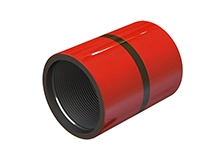
An OCTG coupling is an internally threaded cylindrical connector used to join externally threaded casing or tubing joints of the same specified size and connection within an oil or gas well string.
The coupling is normally supplied with the pipe or purchased as a separate accessory. It may be made from coupling stock with mechanical properties compatible with the connected pipe. Its threads must match the pin thread form, taper, pitch, lead and dimensional requirements. The finished part may include phosphate or another surface treatment, marking and thread protection.
“OCTG coupling” is a category term. A complete order must identify whether the part is a casing coupling or tubing coupling, because casing uses connection families such as STC, LTC and BTC, while API tubing commonly uses NUE and EUE. The order must also state size, grade, standard, product level, quantity, inspection and documentation.
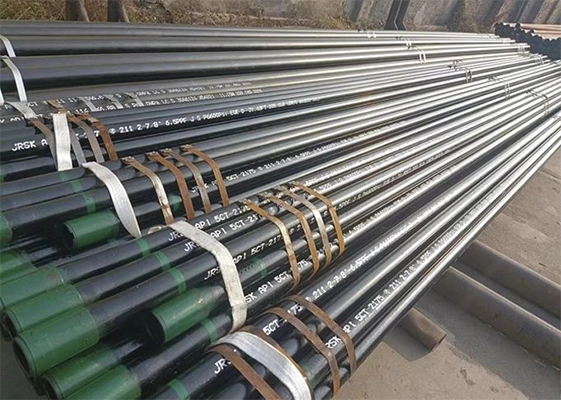
JRSK organizes its OCTG couplings into casing and tubing categories so that buyers can move from a general connection requirement to the correct product family.
The first procurement decision is the service category, because casing and tubing couplings differ in connection families, dimensional envelope and the loads they are expected to transfer.
| Item | Casing Coupling | Tubing Coupling |
|---|---|---|
| Primary string | Connects casing joints that support and isolate the wellbore | Connects production tubing that conveys fluids and supports completion equipment |
| Common API connection families | STC, LTC and BTC | NUE and EUE |
| Typical design emphasis | Structural load, collapse/burst system, cementing and well integrity | Pressure containment, axial load, internal clearance and workover handling |
| Procurement risk | Wrong thread family or grade can prevent make-up or reduce string performance | Wrong upset/connection can conflict with clearance and joint-strength requirements |
Do not accept a quotation that says only “API coupling” without the string type and connection. A casing coupling for 5-1/2-inch LTC is not interchangeable with a 5-1/2-inch BTC coupling, and neither is interchangeable with a tubing coupling. Even within one connection family, size and weight combinations affect thread and coupling dimensions.
When a project needs dedicated casing coupling products, the RFQ should include casing OD, nominal mass or wall, grade, STC/LTC/BTC connection, coupling type, standard edition and any special clearance or coating requirement.
STC, LTC and BTC are standardized casing connection families whose thread geometry and joint behavior differ, so they must be selected from the approved casing design rather than treated as interchangeable labels.
STC means short round thread casing. It uses a round thread form and a shorter engaged length than LTC. It can be economical and common in less demanding applications where its connection efficiency and sealing behavior satisfy the design.
LTC means long round thread casing. It uses the same general round-thread family with a longer engaged length, typically providing greater joint strength than STC for comparable pipe. It also has a longer coupling and different make-up position.
BTC means buttress thread casing. The buttress profile is designed to transfer higher axial load efficiently and is widely used in demanding casing strings. BTC still requires correct compound, handling and make-up; the name does not guarantee gas-tight performance for every service.
| Connection | Thread Family | Relative Engaged Length | Typical Procurement Driver | Common Mistake |
|---|---|---|---|---|
| STC | Short round thread | Shorter | Standard casing service where design loads permit | Substituting it for LTC without recalculating joint strength |
| LTC | Long round thread | Longer | Improved joint strength within the round-thread family | Using the correct size but wrong coupling length or gauge setup |
| BTC | Buttress thread | Distinct buttress engagement | Higher axial-load casing applications | Assuming BTC is automatically premium or gas-tight |
A supplier should confirm the exact connection on the quotation, production traveler, inspection report, marking and packing list. Photographs alone are not sufficient because different threads can look similar to an untrained receiver when protectors and compound obscure the profile.
EUE and NUE tubing couplings match external-upset-end and non-upset-end tubing, and their dimensions must match the pipe-end geometry and approved completion clearance.
EUE tubing has a locally increased pipe-end cross section before threading. Its coupling and upset envelope are generally larger, while its connection can provide higher joint efficiency for many standard combinations. NUE tubing retains the non-upset pipe-body end and provides a slimmer external profile, which can matter when casing drift or completion equipment limits clearance.
The buyer should confirm tubing OD, nominal mass, grade and end finish. “2-7/8 coupling” is incomplete because the part may be EUE or NUE and may need a specific grade, coating, thread compound and marking. When ordering tubing coupling products, include the tubing data sheet or a verified sample reference if the existing string documentation is uncertain.
A field team should never attempt to make up an EUE coupling onto an NUE pin or vice versa. If a replacement coupling does not start freely by hand under proper alignment, stop and verify the connection rather than using torque to force engagement.
Grade matching ensures that coupling material, heat treatment and mechanical properties are compatible with the connected casing or tubing and the purchase specification.
Common OCTG grades include J55, K55, N80, L80 and P110. The coupling may use material and heat treatment specified for the relevant grade family. A supplier should not substitute a generic steel based only on nominal yield strength. Chemical composition, heat treatment, hardness, toughness, manufacturing route and service qualification may matter.
For sour or corrosive service, the grade name is only the beginning. The purchase specification may control hardness, heat treatment, chemistry, sulfide-stress-cracking resistance, traceability and testing. Higher strength can increase sensitivity to environmental cracking if material controls are not appropriate. The operator’s approved material specification should take precedence over an informal “equivalent grade” proposal.
Ask the supplier to identify:
Coupling material grade and applicable standard.
Heat number and heat-treatment route.
Required mechanical tests and acceptance values.
Hardness sampling location and frequency where applicable.
Compatibility with the exact pipe grade and connection.
Any limitations for sour, high-temperature or corrosive service.
A material certificate should identify the delivered lot rather than present a generic sample from a different production run.
Dimensional inspection confirms that the coupling blank and finished geometry provide the correct envelope, thread location, wall and end-face condition before the connection is accepted.
Key dimensions can include outside diameter, overall length, bore, counterbore, end-face squareness, chamfer, thread position and wall distribution. The exact list depends on the connection family. Measuring only coupling outside diameter and length does not verify thread conformity.
Dimensional consistency affects field handling and clearance. An oversized coupling may not pass through a restriction. An incorrect length or counterbore can change thread engagement and make-up position. Poor end-face geometry can complicate handling or indicate a machining-control problem.
The inspection plan should define instrument accuracy, calibration status, sampling frequency and acceptance criteria. For a critical order, the buyer may request first-article inspection, in-process sampling and final random verification. Measurement records should identify the part or lot and the drawing or standard revision used.
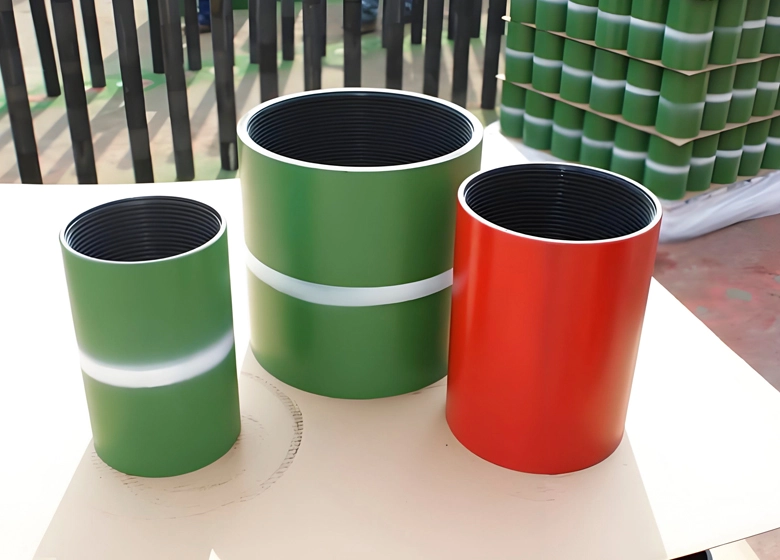
API 5B gauging uses controlled thread gauges and inspection methods to verify standardized casing and tubing thread dimensions, but gauge acceptance must be supported by process control and visual examination.
Working and reference gauges require calibration and traceability. Ring gauges check external threads and plug gauges check internal threads. Standoff or other gauge readings are interpreted according to the applicable connection and procedure. A “gauge passed” statement is incomplete without gauge identification, calibration status, inspection date and acceptance basis.
Thread quality also includes taper, lead, pitch diameter, height, profile, crest and root condition, surface finish, burrs and handling damage. Some characteristics are controlled by process qualification and periodic measurement rather than every-piece inspection. The supplier should have a documented control plan showing which features are checked at setup, during production and at final inspection.
Visual inspection should confirm that threads are free from tears, chatter, dents, corrosion, embedded chips and incomplete form. The coupling bore and counterbore should be clean. Compound or coating should not conceal defects during final acceptance.
Surface treatment and thread compound support controlled make-up, corrosion protection and galling resistance, but they must be compatible with the connection and the purchaser’s environmental and operational requirements.
Phosphate treatment is commonly used on OCTG threads to create a controlled surface for compound retention and make-up. Other coatings or treatments may be specified. The buyer should state whether the coupling is supplied bare, phosphated, coated or pre-applied with a particular compound.
Thread compound is not only a lubricant. It affects friction, make-up behavior, sealing and disassembly. ISO 13678 provides evaluation and testing methods for thread compounds used with casing, tubing, line pipe and drill-stem elements. The field procedure should use the approved compound and application quantity rather than substitute whatever is available at the rig.
Environmental rules increasingly restrict certain metallic ingredients and disposal practices. The buyer should identify regional requirements and operator-approved products. A compound change may alter make-up response, so it should be managed through the connection procedure.
Traceability connects each delivered coupling lot to its material heat, heat treatment, machining records, inspection results, marking and packing identification.
A strong traceability system allows the supplier and buyer to isolate affected parts if a nonconformity is discovered. It also prevents mixing of similar-looking grades or connections. Color bands alone are not enough because paint can be damaged or misapplied; durable marking and documented bundle identification are needed.
The purchase order should define required marking content. Depending on the standard and order, this may include manufacturer identification, size, grade, connection, standard, heat or lot, license mark where authorized, and traceability code. The marking must not damage the part or interfere with make-up.
At receiving, compare the packing list, bundle tags, coupling markings and material certificates. Randomly verify size and connection. Keep different grades and thread families physically separated in storage. A coupling placed in the wrong bin can create a rig-site failure even when the factory manufactured it correctly.
A reliable OCTG coupling supplier demonstrates process capability, gauge control, material traceability and nonconformance management rather than relying only on a certificate image or a low unit price.
| Supplier Evidence | Minimum Acceptable Proof | Stronger Evidence | Warning Sign |
|---|---|---|---|
| Standard capability | Clear statement of applicable API/ISO products | Current license scope and audited quality system | Certificate does not cover the offered product or facility |
| Thread control | Calibrated gauges and inspection procedure | Gauge history, reference-gauge control and statistical process records | Only visual inspection or unidentified gauges |
| Material traceability | MTC linked to lot | Heat-to-part traceability through heat treatment and machining | Generic certificate or missing heat identification |
| Dimensional control | Sampling report | First-article, in-process and final inspection plan | No defined tolerance or measurement method |
| Nonconformance system | Documented segregation and disposition | Root-cause and corrective-action records | Rework performed without authorization or records |
| Export packing | Protectors and identified cartons/crates | Moisture control, impact protection and photo record | Loose mixed couplings with exposed threads |
An API monogram or quality certificate can be important evidence, but the buyer should verify that it is current, belongs to the manufacturing facility and covers the product scope. The certificate does not eliminate the need for an order-specific data sheet, inspection plan and shipment records.
Third-party inspection is effective only when the scope, hold points, sampling and acceptance authority are written before production.
A practical inspection and test plan can include document review, incoming material verification, heat-treatment record review, first-article dimensional inspection, gauge verification, thread visual inspection, coating checks, marking, quantity, packing and loading. Hold points require the supplier to obtain release before continuing, while witness points allow the inspector to attend without necessarily stopping production.
For large orders, sampling should be risk based. Inspecting every low-risk visual feature may add cost without improving control, while failing to witness gauge setup or material segregation can leave critical risks unchecked. The buyer, supplier and inspector should agree how rejected lots are reworked, reinspected and documented.
Factory-conforming couplings can still fail if threads are contaminated, misaligned, over-torqued, cross-threaded or damaged during storage and handling.
Keep protectors installed until inspection and make-up. Store couplings dry, segregated and identified. Do not throw them into steel bins where threads can strike each other. Before use, clean and inspect the coupling and pin, verify connection, apply the approved compound and align the joint.
Power tongs and torque-turn systems should be calibrated and operated under an approved procedure. Standard API connections may use make-up position and field practice defined by the operator, manufacturer and applicable standard. A torque value copied from another size, grade, compound or connection may be incorrect.
If make-up requires abnormal torque, stops early or continues beyond the expected position, break out the connection and investigate. Do not “make it fit” by applying more torque. Check thread damage, wrong connection, compound, alignment and gauge conformity.
Coupling nonconformities can originate in material, heat treatment, machining, gauging, surface treatment, marking, packing or field handling.
Wrong thread family: STC, LTC, BTC, EUE or NUE does not match the pipe pin.
Incorrect grade or mixed lot: marking and MTC do not match the purchase order.
Gauge nonconformance: standoff or other required reading falls outside acceptance.
Thread damage: dents, torn metal, chatter, corrosion, chips or incomplete form.
Dimensional error: coupling length, OD, bore or counterbore does not meet the required drawing or standard.
Poor coating: uneven treatment, contamination, flaking or hidden defects.
Missing traceability: finished parts cannot be linked to heat and inspection records.
Inadequate packing: exposed threads, mixed sizes, moisture ingress or impact damage.
The disposition should identify whether the part can be reworked, requires full reinspection or must be scrapped. Thread rework must be controlled because removing material changes dimensions. Reworked parts should not be returned to the shipment without documented authorization and acceptance.
A complete OCTG coupling RFQ identifies the connected pipe and the required connection so that JRSK can select the correct material, blank, machining program, gauges and inspection plan.
Provide:
Casing or tubing application.
Pipe outside diameter and nominal mass or wall thickness.
Pipe grade and required coupling material grade.
Connection: STC, LTC, BTC, EUE, NUE or approved proprietary reference.
API 5CT, API 5B, ISO 11960 or other governing documents and editions.
Quantity and delivery schedule.
Surface treatment, compound and protector requirements.
Material, dimensional, gauge, hardness, NDT or other inspection requirements.
Marking, traceability, MTC and third-party inspection scope.
Packing method and final destination.
Attach the pipe data sheet when possible. If the purchase is for field replacement and documentation is missing, provide clear photographs, measured dimensions and an approved sample, but do not rely on visual matching alone. JRSK should confirm the required connection before manufacturing.
Ask for a quotation that separates material, machining, coating, inspection, third-party fees and packing where these items materially affect cost. This makes supplier comparisons clearer and prevents a low base price from excluding required quality controls.
A casing coupling connects casing joints used to support and isolate the wellbore, while a tubing coupling connects production tubing that carries fluids to the surface. Casing commonly uses STC, LTC or BTC connections. API tubing commonly uses NUE or EUE. The parts are not interchangeable.
No substitution should be made without an approved engineering and standards review. STC and LTC have different thread engagement and coupling dimensions. A coupling must match the pipe’s specified connection. Forcing mismatched threads can damage both parts and create an unsafe connection.
The coupling material must comply with the applicable standard and purchase specification for the connected pipe grade. The exact material requirements can differ by grade and service. Buyers should require order-specific material certificates and should not accept an undocumented “equivalent” grade.
API 5B provides requirements for threading, gauging and inspection of applicable casing, tubing and line-pipe threads. Gauges help verify standardized thread dimensions, but a complete quality system also controls taper, lead, profile, surface condition, calibration, machining setup and visual defects.
Phosphate treatment can support lubricant retention and controlled make-up. Thread compound affects friction, galling resistance, sealing and break-out. The approved treatment and compound should match the connection procedure and environmental requirements. An unapproved substitute can change make-up behavior.
A typical package includes material certificates, heat-treatment records where applicable, dimensional and gauge inspection, hardness or mechanical-test records, coating information, marking and traceability records, quantity and packing lists. The purchase order should define the exact documents and any third-party witness points.
OCTG coupling procurement should be managed as a connection-quality process, not as a simple purchase of short threaded cylinders. The buyer must identify casing or tubing service, select the correct STC, LTC, BTC, EUE or NUE family, match material and grade, verify dimensions and gauges, control surface treatment and preserve traceability through shipment.
JRSK can prepare a coupling proposal when the connected pipe data, standard, grade, connection, inspection scope and delivery requirements are clear. A disciplined RFQ and inspection plan reduce field mismatch, protect pipe threads and support reliable casing and tubing string assembly.
American Petroleum Institute — API 5CT and API 5B program documents
ISO 13679:2019 — Procedures for testing casing and tubing connections

This is the first one.